
Why did the motor burn out despite being protected? 5 common mistakes in electric drive protection

21.10.2026

Many engineers, machine builders (OEMs), and maintenance teams live under the assumption that simply installing an overcurrent switch fully protects an electric motor from failure. However, industrial reality can be harsh – a sudden odor of burnt insulation, tripped fuses, and an unplanned production line shutdown. The cost of replacing the motor itself is often just a fraction of the losses generated by halted production.

WHY DID THE MOTOR BURN OUT DESPITE BEING PROTECTED? 5 COMMON MISTAKES IN ELECTRIC DRIVE PROTECTION

Many engineers, machine builders (OEMs), and maintenance teams live under the assumption that simply installing an overcurrent switch fully protects an electric motor from failure. However, industrial reality can be harsh – a sudden odor of burnt insulation, tripped fuses, and an unplanned production line shutdown. The cost of replacing the motor itself is often just a fraction of the losses generated by halted production.

Interestingly, a significant portion of three-phase motor damage occurs in installations that theoretically had protection installed. How is this possible? Here are the 5 most common mistakes made during machine design and operation.
1. Incorrect selection and setting of overload protection

The most frequent cause of winding failure is operating the motor in a state of prolonged overload. Even a small but continuous current increase above the nominal value raises the temperature inside the housing and leads to gradual insulation degradation.

  • Practical example: A 5.5 kW motor has a rated current In = 11 A. A designer or technician sets the thermal protection to 15 A (“so the switch doesn’t trip during startup”).
  • Consequence: The switch will not react at a current of 13 A, while the motor windings undergo slow, continuous overloads.

2. Two-phase operation – lack of phase failure protection

The loss of one supply phase is a silent killer of three-phase motors. It can be caused by a blown fuse link, a loose terminal in a junction box, or a damaged contactor.

When one phase fails during operation:

  • The motor does not stop immediately, but tries to maintain its speed.
  • Current consumption in the remaining two phases rises sharply (by 70–100%).
  • Conventional overcurrent protection often reacts too slowly.

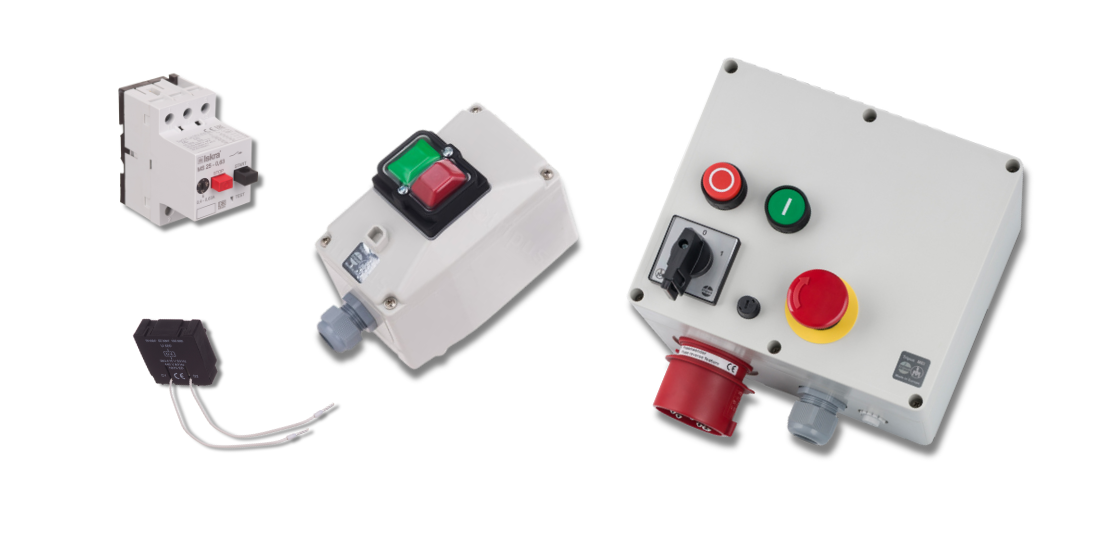
How to prevent this? Dedicated protection sensitive to phase asymmetry and phase loss must be applied. A prime example is the Motor Protection Switch. This device combines the functions of a main switch, short-circuit protection, overload protection, and phase loss sensitivity to disconnect the power supply before the winding structure is damaged.

3. High switching frequency and winding overheating

Every squirrel-cage motor startup involves a brief inrush current that is 5 to 8 times (IE3: 6-10 times) higher than the rated current. In applications with high switching frequencies (e.g., circular saws, compressors, woodworking dust extractors), the accumulated thermal energy cannot dissipate quickly enough into the environment.

For loads with high switching frequencies, a standard motor protection switch is not enough.

  • Technical solution: Direct thermal protection (T1/T2): Utilizing built-in temperature sensors (PTC/bimetal) directly inside the motor winding. Integrated Tripus control systems feature dedicated inputs for thermal contact connections (T1/T2). This guarantees the immediate shutdown of the drive upon exceeding the critical winding temperature – regardless of the operating current being drawn from the grid.

4. Incorrect selection and setting of Star-Delta starters

Star-Delta starting reduces inrush current, but an improperly designed system creates its own risks. The most common errors include:

  • Switching to Delta too early (before the motor has reached the required rotational speed, leading to a current surge).
  • Incorrect setting of the thermal overload relay (during Y – Δ startup, the thermal relay fitted in the delta line is set to 0.58 × In).

Ready-made, automated Star-Delta Starters in an enclosure eliminate this problem thanks to factory-calibrated switching delays (t1, t2) and integrated overload protection taking into account the 0.58 × In conversion factor.

5. Lack of periodic maintenance and loose screw terminals

The final error relates to ongoing operation. Vibrations generated by the running machine cause screw terminals on switches and inside the motor terminal box to gradually loosen over time.

A loose conductor means increased contact resistance, which leads to:

  • Localized heating of connections (frequently leading to housing melting).
  • Localized voltage drops and arcing.
  • Ultimately, phase failure under load and total motor destruction.

Regular thermal imaging audits and tightening electrical connections to the correct torque as part of preventive maintenance are the simplest ways to avoid costly failures.

What else should be considered – what plays a role?

Ignoring environmental conditions (IP Rating) and phase reversers – even the best-selected motor protection switch will fail if dust, sawdust, or moisture enters its enclosure. In harsh environments (woodworking industry, agriculture, construction), standard IP20 protection inside the control cabinet is insufficient.

The use of external switch housings with an IP54 degree of protection reliably shields devices from dust accumulation and water splashes. In the case of mobile machinery, a CEE plug collar with an integrated phase reverser is also an extremely useful feature that allows rapid correction of the motor rotation direction without having to rewire terminals inside the connection box.

Conclusion: motor protection is an investment, not an expense

The cost of a professional motor protection switch, phase monitoring, and a suitable IP protection rating makes up only a tiny fraction of the total value of an electric drive – and is incomparably lower than the cost of a single hour of unplanned downtime on a modern production line.

When planning a new machine or modernizing an existing machinery park, it is worth relying on integrated control and protection systems that combine overload, undervoltage, and environmental protection in a single certified enclosure.

Contact form

In case any technical questions our Technical Department remain for Your disposal

Last posts on the blog

16.09.2026

New in the Tripus range – control boxes with Soft Starters – as an alternative to Star-Delta Starters

Choosing the right motor control and protection system depends on the specific application, technical requirements, and budget. On our blog, we have already covered the correct selection of protection devices for classic Star-Delta (Y-Δ) starting, as well as advanced solutions using Variable Frequency Drives (VFDs). Today, we are expanding our portfolio with another option that […]
19.08.2026

Evolution of Tripus TP3251 switch offer – higher availability and proven reliability

Ensuring the safety and operational continuity of machinery in your facilities is our top priority. To maintain the highest standard of service and ensure even faster order fulfillment, we are introducing a planned update to our industrial switch product line. We are evolving our proven TP3251 series into a unified, modern product line: 61TP.

All posts

Zapytaj o produkt


    This will close in 0 seconds

    Ask about the system


      This will close in 0 seconds

      Fragen zum System


        This will close in 0 seconds

        Zapytaj o system


          This will close in 0 seconds

          Zapytaj o system


            This will close in 0 seconds